A Whale's Tale
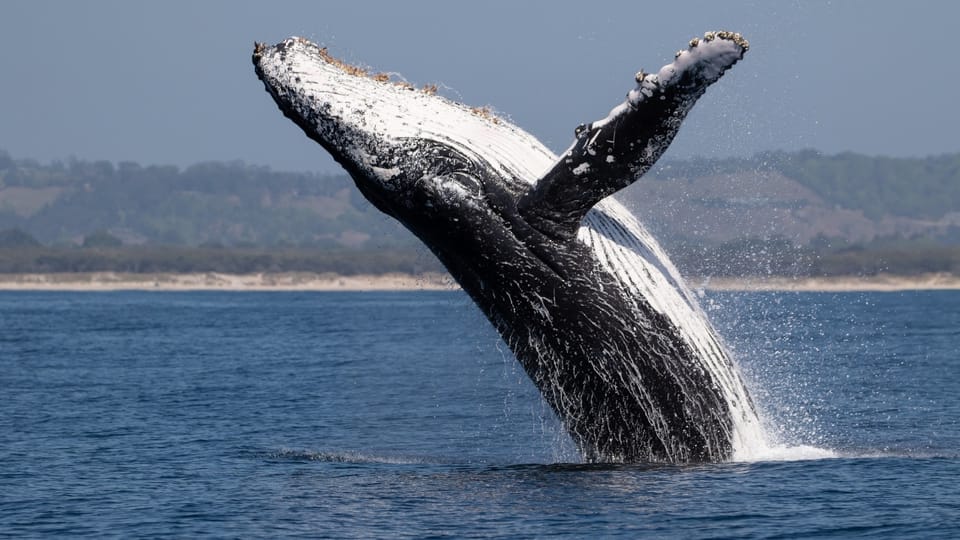
We're sure that when you hear the word 'whales,' your eyes widen, and your speech slows down to a dramatic 'whh--aa--lee--ss!' What is it about these giant water mammals that makes them so special and glorious? It's their size, of course, but how they have evolved over the years to become what they are now is even more interesting.
Whales used to live on land
Whhhaaattt??
Take a minute!
Yes, it's true. In fact, the first whale, Pakicetus, looked nothing like the whales of today. It lived on land but could swim like a dog or a bear. It even resembled a dog. However, Pakicetus' behavior was more like a crocodile, spending much time in marine environments hunting and fishing. To support this, Charles Darwin, in 1859, described a scene of a swimming bear catching insects in the water, similar to how a whale feeds.

The credit for this evolution goes to the emergence of wetlands that provided shallow marine environments for Pakicetus and its descendants to sustain and adapt to aquatic life. And over millions of years, these adaptations through natural selection led to whales evolving to become increasingly marine, eventually becoming what they are today.
Whales and hippopotamuses are long-lost cousins
Hippos? Really? Aren't they supposed to look like pigs? Or horses (as per Greek thought)? But whales?

Based on fossil records and DNA testing, whales share their DNA sequence with only one other animal, the hippopotamus. A theory by Boisserie suggests that both mammals had a common ancestor that lived 50 to 60 million years ago. From that ancestor, two groups evolved: the early cetaceans, which eventually became water mammals, and another group of pig-like animals called anthracotheres, of which only one descendant remains, the hippopotamus. And hippos, you may know, are semi-aquatic animals, spending much of their time in the water, just like their distant cousins, whales. This aquatic adaptation links the two, highlighting their evolutionary connection.
Whales once inhabited the Himalayan region
The magnificent Himalayas were once home to the magnificent whales. How?
A few years ago, paleontologists discovered whale fossils in the Himalayas. It may sound surprising at first, but to understand this, you need to know that the Himalayas were once part of a vast waterbody, the Tethys Sea. Geologist Ashok Sahni confirmed the existence of whales in the Himalayan region when he found a one-inch-long tooth fossil in the mountain foothills, dating back about 50 million years. This tooth belonged to a whale ancestor that once walked on land.
In fact, if you continue reading more about the formation of the Himalayas, you'll learn about many fish and other sea creatures and marine life that once inhabited the Tethys Sea, and their fossils now narrate fascinating stories through the rocks of the Himalayas.
However, all of this didn't happen in the blink of an eye. It took over 13 million years for whales to be where they are and what they are now including the transformation from a dog-like ancestor to a crocodile-like creature and finally to becoming the aquatic inhabitants.
Whales are not as fish-like as you think
You may wonder whale's a fish because it lives in water. But it's quite the opposite of that. You may, by now, know why. But let us tell you in detail. While whales are similar to fish externally in terms of anatomy, internally, whales are more similar to land-based mammals, having adapted physiologically to their aquatic environment.
Whales, along with other cetaceans, including dolphins and porpoises, have more mammal-like properties than fish-like ones. For example, whales breathe air through their lungs like humans and give birth to live calves instead of laying eggs. Similar to humans, whales have relatively long pregnancies, ranging from 10 to 12 months, and give birth to one calf at a time. Since they are not naturally aquatic animals, it is interesting to note that whale calves are born tail first to avoid the risk of drowning.
Whales have evolved to become efficient swimmers, but their anatomical requirements are more like those of mammals. They have evolved to hold their breath for extended periods while diving by storing large amounts of oxygen in their muscles and blood. They often come to the surface to breathe easily through the blowholes located on the top of their heads. Furthermore, whales often rest at the surface of the water so they can get oxygen even while they rest.
So next time someone says, "Whales are fish," give them this whole knowledge about the evolution of whales.